Loading page...
TUES–SUN 10:00–18:00

Processual Yellow

1989

mixed technique, acrylic, hardboard, wood, 161 × 126 × 13 cm

purchased in 2021 with funding from the Czech Ministry of Culture

Painter, graphic artist, creator of objects, teacher. Nešleha studied under Alois Fišárek at the Prague Academy of Arts, Architecture and Design. He ranked among the most prominent figures of the Czech art scene in the 1970s and 80s. In 1971 he won the gold medal (the Premio Césare Sofianopulo) at the Trieste graphic art biennale. In 1975 he won the silver medal for graphic art at the international MIR 75 exhibition, held to mark 30 years since the foundation of the United Nations. Nešleha’s early work still contains residual traces of modernism, but in the 1960s he became increasingly influenced by materiality and the structural features of informel. This tendency remained prominent in all his remaining work. An important feature of Nešleha’s works is his interest in the precise technical depiction of details and the construction of various biomorphic shapes. Thematically, his main focus was on the elements: fire, water, air and earth. His work presents a surrealist integration of specific and indeterminate propositions, mythology, and symbolism. Nešleha also transferred two-dimensional artistic images into three-dimensional objects. Towards the end of his career he moved away from material substance and focused on depicting light.

MERTA VLADIMÍR

(1957, Frýdek-Místek) Painter, sculptor, installation artist. From 1977 to 1983 he studied under Professor Oldřich Oplt at the Prague Academy of Fine Arts. Merta was a prominent figure on the action art scene during the 1980s. From 1998 to 2011 he headed the environment studio at the Art Faculty of Brno Technical University, before moving to the University of West Bohemia in Plzeň, where he took charge of the new media studio at the Institute of Art and Design. His early creative period, in the 1980s, is associated with land-art installations. Later he began to explore paintings and installations in which he combined natural and artificial materials – such as the object Public Geometry (1991), which combines a wooden gallows with a TV screen. In 2002 he created an action entitled Immigrant, with a tree floating upstream along a river to a riverside museum in central Prague to commemorate the floods that had hit the city. Merta’s exhibition at the Critics’ Gallery in 2009, entitled ErRors, presented a cycle of large-scale works combining painting techniques and media perception in the form of “faulty” TV images. The grainy, blurred and pointillistic quality of the images is based on the optical perception of sources emitting light from behind the TV screen, which also gives rise to the media vision. After an analytical exploration of this world, Merta transferred his visual and technical discoveries to canvas – using brushstrokes as well as splattering the surface with paint using large brushes – and installed these paintings as the screens of TV sets in public spaces. In 2010, as a reminiscence of his 1980s Wind Drawings, Merta created a set of abstract paintings using acrylic paint splatters from a brush that was attached to a metal holder and moved at random around the canvas, carried by the motion of the wind.
mixed technique, acrylic, hardboard, wood, 103.5 × 103.5 cm, purchased in 2021 with funding from the Czech Ministry of Culture
1984

Self-portrait

Album 77

Album 77

1977
Girl in a fur

Girl in a fur

undated
Old Eroticism

Old Eroticism

1996
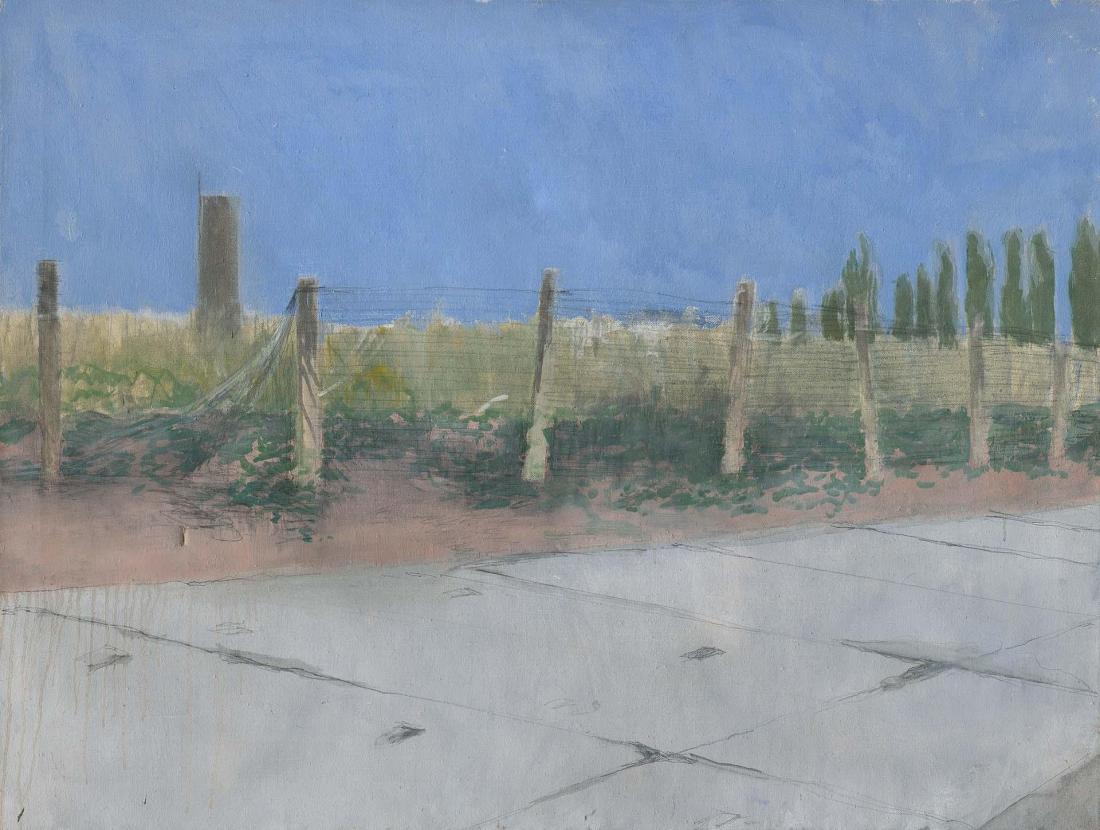
Concrete (Below a Slag-Heap)

Concrete (Below a Slag-Heap)

1983
© 2017 Galerie výtvarného umění v Ostravě, p. o.
Designed by burgrova.tumblr.com     Developed by Ollero